
Note
Go to the end to download the full example code.
08. Metric Evaluation#
This tutorial mainly explains the MetricEvaluator class. It demonstrates
the high-level MetricEvaluator API for quantitative evaluation of
uncertainty and calibration outputs.
It covers:
calibration curves via
MetricEvaluator.calibration_curve;calibration summary metrics via
MetricEvaluator.calibration_metrics_4;combined error and uncertainty summaries via
MetricEvaluator.evaluate_all;fixed-orientation and free-orientation EEG examples.
Scientific motivation#
After source estimation and uncertainty estimation, CaliBrain needs a compact way to answer three questions:
how accurate are the reconstructed source signals?
how large is the posterior uncertainty on average?
how well do empirical coverages match nominal coverages?
MetricEvaluator is the high-level class that summarizes these quantities.
It wraps UncertaintyEstimator and exposes workflow-facing evaluation
methods.
import matplotlib.pyplot as plt
import numpy as np
from mne.io.constants import FIFF

from calibrain import (
    MetricEvaluator,
    SensorSimulator,
    SourceEstimator,
    SourceSimulator,
    UncertaintyEstimator,
    gamma_map_sflex,
)


RANDOM_SEED = 71
Build a lightweight evaluation fixture#
The tutorial generates two small synthetic examples:
one fixed-orientation example;
one free-orientation EEG example.
Both use the active gamma_map_sflex solver and the same uncertainty grid.
erp_config = {
    "tmin": -0.1,
    "tmax": 0.8,
    "stim_onset": 0.0,
    "sfreq": 100,
    "fmin": 2,
    "fmax": 8,
    "amplitude_distribution": {
        "median": 8.0,
        "sigma": 0.15,
        "clip": [2.0, 20.0],
    },
    "random_erp_timing": False,
    "erp_min_length": 20,
}

nominal_coverages = np.linspace(0.0, 1.0, 11)
ue = UncertaintyEstimator(nominal_coverages=nominal_coverages)
metric_evaluator = MetricEvaluator(ue)
source_simulator = SourceSimulator(ERP_config=erp_config)
sensor_simulator = SensorSimulator()
times = np.arange(erp_config["tmin"], erp_config["tmax"], 1.0 / erp_config["sfreq"])

rng = np.random.default_rng(RANDOM_SEED)
n_sensors = 16
n_sources = 32
src_coords = rng.normal(scale=0.04, size=(n_sources, 3))

leadfield_fixed = rng.normal(scale=0.03, size=(n_sensors, n_sources))
leadfield_fixed /= np.maximum(
    np.linalg.norm(leadfield_fixed, axis=0, keepdims=True),
    np.finfo(float).eps,
)
leadfield_fixed *= 0.6

leadfield_free_eeg = rng.normal(scale=0.015, size=(n_sensors, n_sources, 3))
leadfield_free_eeg /= np.maximum(
    np.linalg.norm(leadfield_free_eeg, axis=0, keepdims=True),
    np.finfo(float).eps,
)
leadfield_free_eeg *= 0.4

sensor_simulator.set_sensor_metadata(
    kind=FIFF.FIFFV_EEG_CH,
    units=FIFF.FIFF_UNIT_V,
    unitmult=FIFF.FIFF_UNITM_MU,
    coil_type=FIFF.FIFFV_COIL_EEG,
)
Fixed-orientation evaluation#
For fixed orientation, MetricEvaluator works with:
x_trueandx_hatof shape(N, T);uncertainty as either
posterior_varor fullposterior_cov.
x_true_fixed, active_fixed = source_simulator.simulate(
    n_sources=n_sources,
    nnz=4,
    orientation_type="fixed",
    seed=RANDOM_SEED,
)

y_fixed_clean, y_fixed_noisy, fixed_noise, fixed_eta = sensor_simulator.simulate(
    x=x_true_fixed,
    L=leadfield_fixed,
    alpha_SNR=0.7,
    sensor_white_noise_std=0.2,
    seed=RANDOM_SEED,
)
fixed_noise_var = float(np.var(fixed_noise))

fixed_estimator = SourceEstimator(
    solver=gamma_map_sflex,
    solver_params={"max_iter": 150, "tol": 1e-7, "sigma": 0.01, "src_coords": src_coords},
    noise_var=fixed_noise_var,
    n_orient=1,
)
fixed_estimator.fit(leadfield_fixed, y_fixed_noisy)
fixed_result = fixed_estimator.predict()

fixed_curve = metric_evaluator.calibration_curve(
    x_true=x_true_fixed,
    x_hat=fixed_result["posterior_mean"],
    posterior_uncert=fixed_result["posterior_cov"],
    setting="fixed",
    mode="aggregated",
)
fixed_summary = metric_evaluator.evaluate_all(
    x_true=x_true_fixed,
    x_hat=fixed_result["posterior_mean"],
    posterior_uncert=fixed_result["posterior_cov"],
    setting="fixed",
    mode="aggregated",
)

print("fixed calibration curve keys:", sorted(fixed_curve.keys()))
print("fixed calibration metrics:", fixed_curve["metrics_4"])
print("fixed evaluate_all keys:", sorted(fixed_summary.keys()))
print("fixed mean posterior std:", fixed_summary["mean_posterior_std"])
fixed calibration curve keys: ['empirical', 'metrics_4', 'nominal']
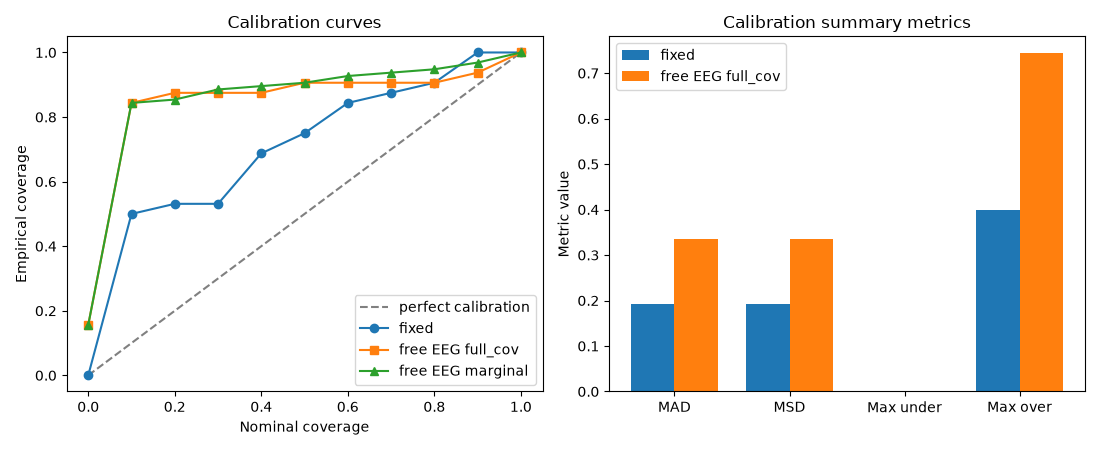
fixed calibration metrics: {'max_underconfidence_deviation': 0.0, 'max_overconfidence_deviation': 0.4, 'mean_absolute_deviation': 0.19318181818181815, 'mean_signed_deviation': 0.19318181818181815}
fixed evaluate_all keys: ['calibration', 'mae', 'mean_posterior_std', 'mse', 'rmae', 'rmse']
fixed mean posterior std: 0.019154597617136844
Free-orientation EEG evaluation#
For free-orientation EEG, MetricEvaluator supports two interval types:
marginal: pooled component-wise intervals;full_cov: local 3D covariance blocks.
Both are evaluated below in aggregated mode.
x_true_free, active_free = source_simulator.simulate(
    n_sources=n_sources,
    nnz=4,
    orientation_type="free",
    coil_type=FIFF.FIFFV_COIL_EEG,
    seed=RANDOM_SEED + 1,
)

y_free_clean, y_free_noisy, free_noise, free_eta = sensor_simulator.simulate(
    x=x_true_free,
    L=leadfield_free_eeg,
    alpha_SNR=0.7,
    sensor_white_noise_std=0.05,
    seed=RANDOM_SEED + 1,
)
free_noise_var = float(np.var(free_noise))

free_estimator = SourceEstimator(
    solver=gamma_map_sflex,
    solver_params={"max_iter": 150, "tol": 1e-7, "sigma": 0.01, "src_coords": src_coords},
    noise_var=free_noise_var,
    n_orient=3,
)
free_estimator.fit(leadfield_free_eeg, y_free_noisy)
free_result = free_estimator.predict()

free_curve_marginal = metric_evaluator.calibration_curve(
    x_true=x_true_free,
    x_hat=free_result["posterior_mean_reshaped"],
    posterior_uncert=free_result["posterior_cov"],
    setting="eeg_free",
    mode="aggregated",
    free_interval_type="marginal",
)
free_curve_full_cov = metric_evaluator.calibration_curve(
    x_true=x_true_free,
    x_hat=free_result["posterior_mean_reshaped"],
    posterior_uncert=free_result["posterior_cov"],
    setting="eeg_free",
    mode="aggregated",
    free_interval_type="full_cov",
)
free_summary = metric_evaluator.evaluate_all(
    x_true=x_true_free,
    x_hat=free_result["posterior_mean_reshaped"],
    posterior_uncert=free_result["posterior_cov"],
    setting="eeg_free",
    mode="aggregated",
    free_interval_type="full_cov",
)

print("free marginal calibration metrics:", free_curve_marginal["metrics_4"])
print("free full_cov calibration metrics:", free_curve_full_cov["metrics_4"])
print("free evaluate_all mse:", free_summary["mse"])
print("free evaluate_all mean posterior std:", free_summary["mean_posterior_std"])
free marginal calibration metrics: {'max_underconfidence_deviation': 0.0, 'max_overconfidence_deviation': 0.74375, 'mean_absolute_deviation': 0.34753787878787873, 'mean_signed_deviation': 0.34753787878787873}
free full_cov calibration metrics: {'max_underconfidence_deviation': 0.0, 'max_overconfidence_deviation': 0.74375, 'mean_absolute_deviation': 0.3352272727272727, 'mean_signed_deviation': 0.3352272727272727}
free evaluate_all mse: 0.004249153282609895
free evaluate_all mean posterior std: 0.0140126642270974
Compare calibration summary metrics directly#
calibration_metrics_4 can also be called directly on nominal and empirical
coverage arrays. This is useful when calibration curves are already available
and only the summary metrics need to be recomputed.
fixed_metrics_direct = metric_evaluator.calibration_metrics_4(
    fixed_curve["nominal"],
    fixed_curve["empirical"],
)
free_metrics_direct = metric_evaluator.calibration_metrics_4(
    free_curve_full_cov["nominal"],
    free_curve_full_cov["empirical"],
)

print("fixed direct metrics:", fixed_metrics_direct)
print("free direct metrics:", free_metrics_direct)
fixed direct metrics: {'max_underconfidence_deviation': 0.0, 'max_overconfidence_deviation': 0.4, 'mean_absolute_deviation': 0.19318181818181815, 'mean_signed_deviation': 0.19318181818181815}
free direct metrics: {'max_underconfidence_deviation': 0.0, 'max_overconfidence_deviation': 0.74375, 'mean_absolute_deviation': 0.3352272727272727, 'mean_signed_deviation': 0.3352272727272727}
Plot calibration and evaluation summaries#
The first panel compares the fixed and free-EEG calibration curves. The second panel summarizes the default calibration metrics.
metric_names = [
    "mean_absolute_deviation",
    "mean_signed_deviation",
    "max_underconfidence_deviation",
    "max_overconfidence_deviation",
]
fixed_metric_values = [fixed_curve["metrics_4"][name] for name in metric_names]
free_metric_values = [free_curve_full_cov["metrics_4"][name] for name in metric_names]

fig, axes = plt.subplots(1, 2, figsize=(11, 4.5))
axes[0].plot([0, 1], [0, 1], "--", color="0.5", label="perfect calibration")
axes[0].plot(fixed_curve["nominal"], fixed_curve["empirical"], marker="o", label="fixed")
axes[0].plot(
    free_curve_full_cov["nominal"],
    free_curve_full_cov["empirical"],
    marker="s",
    label="free EEG full_cov",
)
axes[0].plot(
    free_curve_marginal["nominal"],
    free_curve_marginal["empirical"],
    marker="^",
    label="free EEG marginal",
)
axes[0].set(
    xlabel="Nominal coverage",
    ylabel="Empirical coverage",
    title="Calibration curves",
)
axes[0].legend(loc="best")

bar_positions = np.arange(len(metric_names))
bar_width = 0.38
axes[1].bar(bar_positions - bar_width / 2, fixed_metric_values, width=bar_width, label="fixed")
axes[1].bar(bar_positions + bar_width / 2, free_metric_values, width=bar_width, label="free EEG full_cov")
axes[1].set(
    xticks=bar_positions,
    xticklabels=[
        "MAD",
        "MSD",
        "Max under",
        "Max over",
    ],
    ylabel="Metric value",
    title="Calibration summary metrics",
)
axes[1].legend(loc="best")
fig.tight_layout()
Inspect the combined evaluation output#
evaluate_all combines error metrics, uncertainty summary, and calibration
summary into one dictionary.
for key in ["mse", "mae", "rmse", "rmae", "mean_posterior_std", "calibration"]:
    print(f"fixed evaluate_all[{key!r}] =", fixed_summary[key])
fixed evaluate_all['mse'] = 0.0004689190050340884
fixed evaluate_all['mae'] = 0.012077275043368751
fixed evaluate_all['rmse'] = 0.02165453774695014
fixed evaluate_all['rmae'] = 0.10989665619739643
fixed evaluate_all['mean_posterior_std'] = 0.019154597617136844
fixed evaluate_all['calibration'] = {'nominal': array([0. , 0.1, 0.2, 0.3, 0.4, 0.5, 0.6, 0.7, 0.8, 0.9, 1. ]), 'empirical': array([0.     , 0.5    , 0.53125, 0.53125, 0.6875 , 0.75   , 0.84375,
       0.875  , 0.90625, 1.     , 1.     ]), 'metrics_4': {'max_underconfidence_deviation': 0.0, 'max_overconfidence_deviation': 0.4, 'mean_absolute_deviation': 0.19318181818181815, 'mean_signed_deviation': 0.19318181818181815}}
Summary#
MetricEvaluator is the high-level evaluation class used after uncertainty
estimation and calibration.
In this tutorial it was used to:
compute aggregated calibration curves;
summarize them with the default four calibration metrics;
compare
marginalandfull_covfree-EEG uncertainty;collect reconstruction and uncertainty summaries with
evaluate_all.
Total running time of the script: (0 minutes 0.331 seconds)