
Note
Go to the end to download the full example code.
05. Source Estimation#
This tutorial mainly explains the SourceEstimator class. It demonstrates
the current CaliBrain source-estimation interface using the active inverse
solvers that are still part of the pipeline:
gamma_map_sflexfor sparse Bayesian estimation with an sFLEX basis;gamma_lambda_map_sflexfor the sFLEX variant with joint noise learning;BMNfor Bayesian minimum-norm estimation with fixed noise variance;BMN_jointfor Bayesian minimum-norm estimation with joint noise learning.
The examples cover:
fixed-orientation source estimation;
comparison of sparse and minimum-norm posterior summaries;
free-orientation EEG source estimation with a 3-component leadfield;
explicit use of the workflow noise modes
oracle,baseline, andadaptive_joint_learning.
Scientific motivation#
Source estimation in CaliBrain reconstructs latent source activity x from
sensor measurements y and a leadfield L:
y = L x + noise
The output is not only a point estimate. Current solvers return posterior summaries that are later consumed by uncertainty estimation and calibration:
posterior_mean: reconstructed source time courses;posterior_cov: posterior covariance in coefficient space;solver-specific diagnostics such as active sets, learned hyperparameters, or learned noise levels.
Units remain consistent across the workflow:
source amplitudes are simulated in
nAm;EEG leadfields are interpreted as
µV / nAm;source coordinates for sFLEX are in
m;resulting sensor traces are therefore in
µV.
import matplotlib.pyplot as plt
import numpy as np
from mne.io.constants import FIFF

from calibrain import (
    BMN,
    BMN_joint,
    SensorSimulator,
    SourceEstimator,
    SourceSimulator,
    gamma_lambda_map_sflex,
    gamma_map_sflex,
)


RANDOM_SEED = 41
Build a lightweight simulation setup#
The source simulator generates sparse ERP-like activity. We then construct small synthetic EEG leadfields so the tutorial runs quickly during docs builds.
The parameter meanings are the same as in the source-simulation tutorial:
tminandtmaxdefine the simulated time window in seconds;stim_onsetmarks the ERP onset;sfreqis the sampling frequency in Hz;amplitude_distributioncontrols source amplitudes innAm.
For the sFLEX solvers we also need source coordinates. Here they are small
synthetic positions in meters. sigma=0.01 therefore means a spatial scale
of 10 mm.
erp_config = {
    "tmin": -0.1,
    "tmax": 0.8,
    "stim_onset": 0.0,
    "sfreq": 100,
    "fmin": 2,
    "fmax": 8,
    "amplitude_distribution": {
        "median": 8.0,
        "sigma": 0.15,
        "clip": [2.0, 20.0],
    },
    "random_erp_timing": False,
    "erp_min_length": 20,
}

times = np.arange(erp_config["tmin"], erp_config["tmax"], 1.0 / erp_config["sfreq"])
source_simulator = SourceSimulator(ERP_config=erp_config)
sensor_simulator = SensorSimulator()

rng = np.random.default_rng(RANDOM_SEED)
n_sensors = 16
n_sources = 32
src_coords = rng.normal(scale=0.04, size=(n_sources, 3))

leadfield_fixed = rng.normal(scale=0.03, size=(n_sensors, n_sources))
leadfield_fixed /= np.maximum(
    np.linalg.norm(leadfield_fixed, axis=0, keepdims=True),
    np.finfo(float).eps,
)
leadfield_fixed *= 0.6

leadfield_free_eeg = rng.normal(scale=0.015, size=(n_sensors, n_sources, 3))
leadfield_free_eeg /= np.maximum(
    np.linalg.norm(leadfield_free_eeg, axis=0, keepdims=True),
    np.finfo(float).eps,
)
leadfield_free_eeg *= 0.4

sensor_simulator.set_sensor_metadata(
    kind=FIFF.FIFFV_EEG_CH,
    units=FIFF.FIFF_UNIT_V,
    unitmult=FIFF.FIFF_UNITM_MU,
    coil_type=FIFF.FIFFV_COIL_EEG,
)
Fixed-orientation example#
Fixed orientation uses one coefficient per source, so the leadfield has shape
(n_sensors, n_sources) and the posterior mean has shape
(n_sources, n_times).
x_true_fixed, active_fixed = source_simulator.simulate(
    n_sources=n_sources,
    nnz=4,
    orientation_type="fixed",
    seed=RANDOM_SEED,
)

y_fixed_clean, y_fixed_noisy, fixed_noise, fixed_eta = sensor_simulator.simulate(
    x=x_true_fixed,
    L=leadfield_fixed,
    alpha_SNR=0.7,
    sensor_white_noise_std=0.2,
    seed=RANDOM_SEED,
)

tmin = erp_config["tmin"]
stim_onset = erp_config["stim_onset"]
sfreq = erp_config["sfreq"]
pre_stimulus_onset = int((stim_onset - tmin) * sfreq)
y_fixed_pre = y_fixed_noisy[:, :pre_stimulus_onset]

oracle_noise_var = float(np.var(fixed_noise))
baseline_noise_var = float(np.mean(np.std(y_fixed_pre, axis=1) ** 2))

print("fixed source shape:", x_true_fixed.shape)
print("fixed sensor shape:", y_fixed_noisy.shape)
print("fixed active sources:", active_fixed)
print("fixed eta:", fixed_eta)
print("oracle noise variance:", oracle_noise_var)
print("baseline noise variance:", baseline_noise_var)
print("adaptive joint learning noise variance:", None)
fixed source shape: (32, 90)
fixed sensor shape: (16, 90)
fixed active sources: [11 31 10 24]
fixed eta: 1.82281324753165
oracle noise variance: 0.1397447217185092
baseline noise variance: 0.11194502692152937
adaptive joint learning noise variance: None
Workflow noise modes#
The active workflow uses three named noise modes:
oracle: usevar(noise)from the injected sensor noise;baseline: estimate variance from the pre-stimulus sensor segment;adaptive_joint_learning: passnoise_var=Noneand let the solver learn a common noise level jointly from the data.
The code below uses these names directly in the solver comparison.
solver_outputs = {}
solver_specs = [
    (
        "gamma_map_sflex_oracle",
        gamma_map_sflex,
        {"max_iter": 150, "tol": 1e-7, "sigma": 0.01, "src_coords": src_coords},
        oracle_noise_var,
    ),
    (
        "gamma_map_sflex_baseline",
        gamma_map_sflex,
        {"max_iter": 150, "tol": 1e-7, "sigma": 0.01, "src_coords": src_coords},
        baseline_noise_var,
    ),
    (
        "gamma_lambda_map_sflex_adaptive_joint_learning",
        gamma_lambda_map_sflex,
        {
            "max_iter": 150,
            "tol": 1e-7,
            "sigma": 0.01,
            "src_coords": src_coords,
            "learn_lambda": True,
        },
        None,
    ),
    (
        "BMN_oracle",
        BMN,
        {"max_iter": 300, "tol": 1e-7, "normalization": False},
        oracle_noise_var,
    ),
    (
        "BMN_baseline",
        BMN,
        {"max_iter": 300, "tol": 1e-7, "normalization": False},
        baseline_noise_var,
    ),
    (
        "BMN_joint_adaptive_joint_learning",
        BMN_joint,
        {"max_iter": 300, "tol": 1e-7, "normalization": False, "learn_noise": True},
        None,
    ),
]

for name, solver, solver_params, noise_var in solver_specs:
    estimator = SourceEstimator(
        solver=solver,
        solver_params=solver_params,
        noise_var=noise_var,
        n_orient=1,
    )
    estimator.fit(leadfield_fixed, y_fixed_noisy)
    solver_outputs[name] = estimator.predict()

for name, result in solver_outputs.items():
    print(f"{name} result keys:", sorted(result.keys()))
    print(f"{name} posterior_mean shape:", result["posterior_mean"].shape)
    print(f"{name} posterior_cov shape:", result["posterior_cov"].shape)
    print(f"{name} learned or used noise_var:", result.get("noise_var"))
gamma_map_sflex_oracle result keys: ['B_spatial', 'active_indices', 'active_source_indices', 'coefficient_indices', 'gamma', 'gammas_full', 'n_iter', 'n_orient', 'noise_var', 'posterior_cov', 'posterior_cov_coeff', 'posterior_mean', 'posterior_mean_coeff', 'source_indices']
gamma_map_sflex_oracle posterior_mean shape: (32, 90)
gamma_map_sflex_oracle posterior_cov shape: (32, 32)
gamma_map_sflex_oracle learned or used noise_var: 0.1397447217185092
gamma_map_sflex_baseline result keys: ['B_spatial', 'active_indices', 'active_source_indices', 'coefficient_indices', 'gamma', 'gammas_full', 'n_iter', 'n_orient', 'noise_var', 'posterior_cov', 'posterior_cov_coeff', 'posterior_mean', 'posterior_mean_coeff', 'source_indices']
gamma_map_sflex_baseline posterior_mean shape: (32, 90)
gamma_map_sflex_baseline posterior_cov shape: (32, 32)
gamma_map_sflex_baseline learned or used noise_var: 0.11194502692152937
gamma_lambda_map_sflex_adaptive_joint_learning result keys: ['B_operator', 'active_indices', 'coefficient_indices', 'err_gamma_hist', 'gamma', 'gammas_full', 'lambda_mean', 'lambda_mean_hist', 'lambdas', 'n_active_hist', 'noise_var', 'posterior_cov', 'posterior_cov_active', 'posterior_cov_active_coeff', 'posterior_cov_coeff', 'posterior_mean', 'posterior_mean_coeff', 'source_indices']
gamma_lambda_map_sflex_adaptive_joint_learning posterior_mean shape: (32, 90)
gamma_lambda_map_sflex_adaptive_joint_learning posterior_cov shape: (32, 32)
gamma_lambda_map_sflex_adaptive_joint_learning learned or used noise_var: 0.11186522283608982
BMN_oracle result keys: ['active_indices', 'coefficient_indices', 'gamma', 'noise_var', 'posterior_cov', 'posterior_mean', 'source_indices']
BMN_oracle posterior_mean shape: (32, 90)
BMN_oracle posterior_cov shape: (32, 32)
BMN_oracle learned or used noise_var: 0.1397447217185092
BMN_baseline result keys: ['active_indices', 'coefficient_indices', 'gamma', 'noise_var', 'posterior_cov', 'posterior_mean', 'source_indices']
BMN_baseline posterior_mean shape: (32, 90)
BMN_baseline posterior_cov shape: (32, 32)
BMN_baseline learned or used noise_var: 0.11194502692152937
BMN_joint_adaptive_joint_learning result keys: ['active_indices', 'coefficient_indices', 'err_gamma_hist', 'gamma', 'gamma_hist', 'lambda', 'lambda_hist', 'noise_var', 'noise_var_hist', 'posterior_cov', 'posterior_mean', 'source_indices']
BMN_joint_adaptive_joint_learning posterior_mean shape: (32, 90)
BMN_joint_adaptive_joint_learning posterior_cov shape: (32, 32)
BMN_joint_adaptive_joint_learning learned or used noise_var: 2.904477730519163e-13
Inspect fixed-orientation posterior summaries#
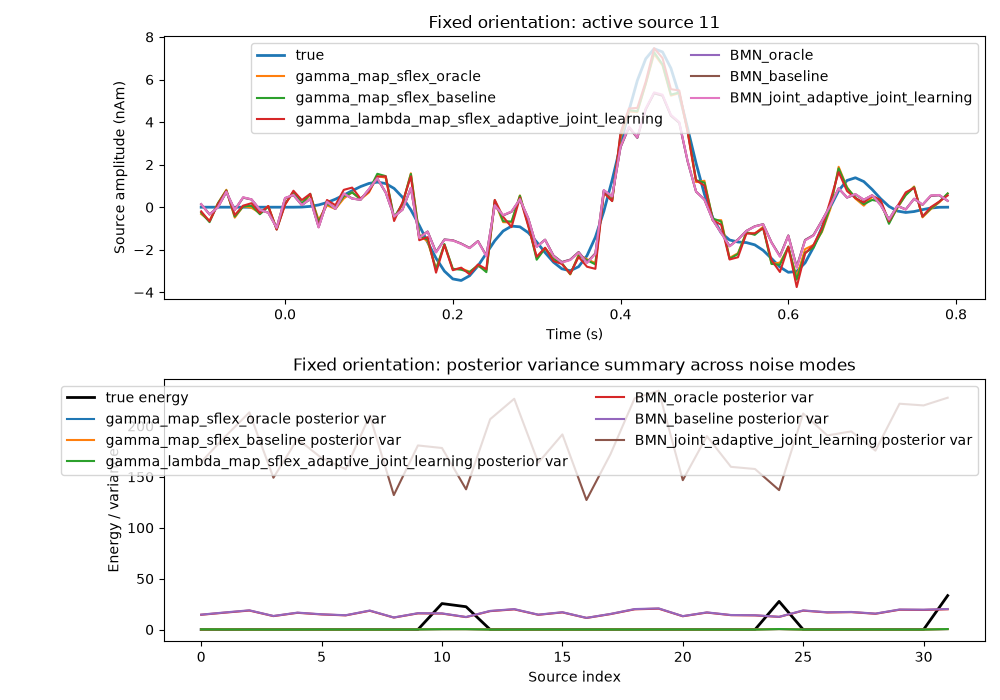
A useful first check is whether the reconstructed activity on a true active source follows the simulated ERP, and how the source-wise posterior variance differs across sparse and minimum-norm estimators under different noise modes.
fixed_source_idx = int(np.atleast_1d(active_fixed)[0])
source_energy_true = np.linalg.norm(x_true_fixed, axis=1)
source_axis = np.arange(n_sources)
plot_order = [
    "gamma_map_sflex_oracle",
    "gamma_map_sflex_baseline",
    "gamma_lambda_map_sflex_adaptive_joint_learning",
    "BMN_oracle",
    "BMN_baseline",
    "BMN_joint_adaptive_joint_learning",
]

fig, axes = plt.subplots(2, 1, figsize=(10, 7), sharex=False)
axes[0].plot(times, x_true_fixed[fixed_source_idx], label="true", linewidth=2)
for name in plot_order:
    axes[0].plot(times, solver_outputs[name]["posterior_mean"][fixed_source_idx], label=name)
axes[0].set(
    xlabel="Time (s)",
    ylabel="Source amplitude (nAm)",
    title=f"Fixed orientation: active source {fixed_source_idx}",
)
axes[0].legend(loc="best", ncol=2)

axes[1].plot(source_axis, source_energy_true, label="true energy", linewidth=2, color="black")
for name in plot_order:
    axes[1].plot(source_axis, np.diag(solver_outputs[name]["posterior_cov"]), label=f"{name} posterior var")
axes[1].set(
    xlabel="Source index",
    ylabel="Energy / variance",
    title="Fixed orientation: posterior variance summary across noise modes",
)
axes[1].legend(loc="upper right", ncol=2)
fig.tight_layout()
Free-orientation EEG example#
Free-orientation EEG uses three coefficients per source. SourceEstimator
accepts a leadfield of shape (n_sensors, n_sources, 3) and internally
reshapes it for the solver. The result contains both posterior_mean in
flattened coefficient space and posterior_mean_reshaped with shape
(n_sources, 3, n_times).
Here we again use the workflow noise modes directly: gamma_map_sflex with
oracle and baseline, and BMN_joint with
adaptive_joint_learning.
x_true_free, active_free = source_simulator.simulate(
    n_sources=n_sources,
    nnz=4,
    orientation_type="free",
    coil_type=FIFF.FIFFV_COIL_EEG,
    seed=RANDOM_SEED + 1,
)

y_free_clean, y_free_noisy, free_noise, free_eta = sensor_simulator.simulate(
    x=x_true_free,
    L=leadfield_free_eeg,
    alpha_SNR=0.7,
    sensor_white_noise_std=0.05,
    seed=RANDOM_SEED + 1,
)

free_oracle_noise_var = float(np.var(free_noise))
y_free_pre = y_free_noisy[:, :pre_stimulus_onset]
free_baseline_noise_var = float(np.mean(np.std(y_free_pre, axis=1) ** 2))

free_solver_outputs = {}
free_solver_specs = [
    (
        "gamma_map_sflex_oracle",
        gamma_map_sflex,
        {"max_iter": 150, "tol": 1e-7, "sigma": 0.01, "src_coords": src_coords},
        free_oracle_noise_var,
    ),
    (
        "gamma_map_sflex_baseline",
        gamma_map_sflex,
        {"max_iter": 150, "tol": 1e-7, "sigma": 0.01, "src_coords": src_coords},
        free_baseline_noise_var,
    ),
    (
        "BMN_joint_adaptive_joint_learning",
        BMN_joint,
        {"max_iter": 300, "tol": 1e-7, "normalization": False, "learn_noise": True},
        None,
    ),
]

for name, solver, solver_params, noise_var in free_solver_specs:
    estimator = SourceEstimator(
        solver=solver,
        solver_params=solver_params,
        noise_var=noise_var,
        n_orient=3,
    )
    estimator.fit(leadfield_free_eeg, y_free_noisy)
    free_solver_outputs[name] = estimator.predict()

print("free EEG source shape:", x_true_free.shape)
print("free EEG sensor shape:", y_free_noisy.shape)
print("free EEG oracle noise variance:", free_oracle_noise_var)
print("free EEG baseline noise variance:", free_baseline_noise_var)
for name, result in free_solver_outputs.items():
    print(f"free EEG {name} posterior_mean shape:", result["posterior_mean"].shape)
    print(
        f"free EEG {name} posterior_mean_reshaped shape:",
        result["posterior_mean_reshaped"].shape,
    )
print("free EEG eta:", free_eta)
free EEG source shape: (32, 3, 90)
free EEG sensor shape: (16, 90)
free EEG oracle noise variance: 0.1779559447265109
free EEG baseline noise variance: 0.1256751978489976
free EEG gamma_map_sflex_oracle posterior_mean shape: (96, 90)
free EEG gamma_map_sflex_oracle posterior_mean_reshaped shape: (32, 3, 90)
free EEG gamma_map_sflex_baseline posterior_mean shape: (96, 90)
free EEG gamma_map_sflex_baseline posterior_mean_reshaped shape: (32, 3, 90)
free EEG BMN_joint_adaptive_joint_learning posterior_mean shape: (96, 90)
free EEG BMN_joint_adaptive_joint_learning posterior_mean_reshaped shape: (32, 3, 90)
free EEG eta: 8.548177454900985
Plot vector norms for one free-orientation source#
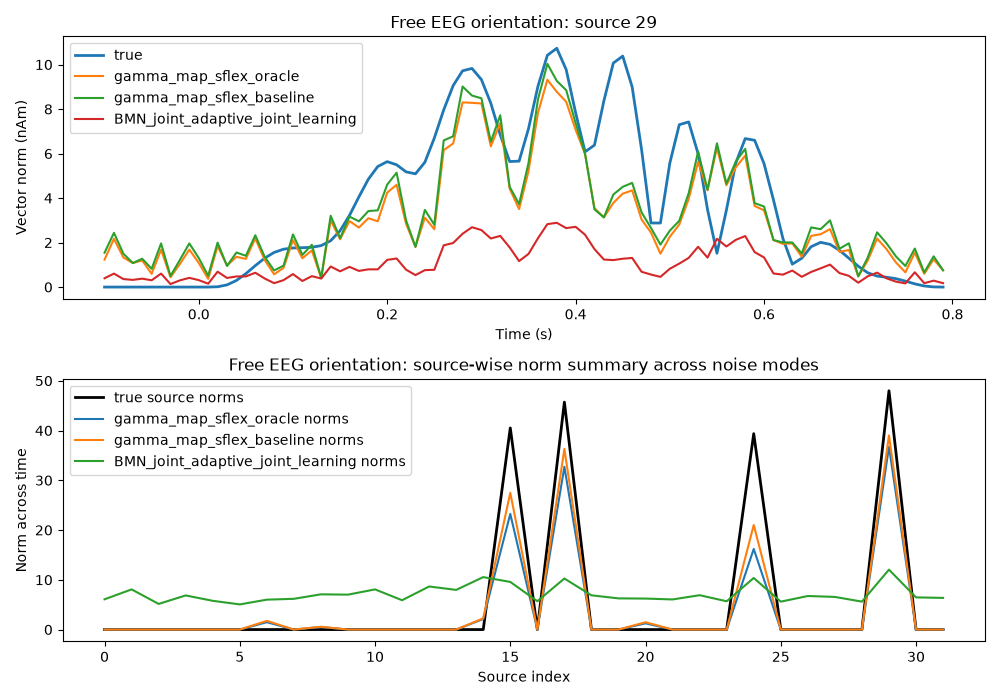
For free orientation, a source has a 3-component time series. A simple scalar summary is the Euclidean norm across orientation components.
free_source_idx = int(np.atleast_1d(active_free)[0])
true_free_component_norm = np.linalg.norm(x_true_free, axis=1)

fig, axes = plt.subplots(2, 1, figsize=(10, 7), sharex=False)
axes[0].plot(times, true_free_component_norm[free_source_idx], label="true", linewidth=2)
for name, result in free_solver_outputs.items():
    est_norm = np.linalg.norm(result["posterior_mean_reshaped"], axis=1)
    axes[0].plot(times, est_norm[free_source_idx], label=name)
axes[0].set(
    xlabel="Time (s)",
    ylabel="Vector norm (nAm)",
    title=f"Free EEG orientation: source {free_source_idx}",
)
axes[0].legend(loc="best")

axes[1].plot(
    np.arange(n_sources),
    np.linalg.norm(true_free_component_norm, axis=1),
    label="true source norms",
    linewidth=2,
    color="black",
)
for name, result in free_solver_outputs.items():
    est_norm = np.linalg.norm(result["posterior_mean_reshaped"], axis=1)
    axes[1].plot(np.arange(n_sources), np.linalg.norm(est_norm, axis=1), label=f"{name} norms")
axes[1].set(
    xlabel="Source index",
    ylabel="Norm across time",
    title="Free EEG orientation: source-wise norm summary across noise modes",
)
axes[1].legend(loc="best")
fig.tight_layout()
Summary#
SourceEstimator is the main reconstruction wrapper used in the current
CaliBrain pipeline. It standardizes solver invocation and returns posterior
summaries that later feed uncertainty estimation, aggregation, and
calibration.
In practice:
use
oraclewhen the simulated sensor noise is available and you want the matched reference variance;use
baselinewhen the noise level should be estimated from the pre-stimulus sensor segment;use
adaptive_joint_learningwhen the solver should learn a common noise level jointly from the data;pair those modes with
gamma_map_sflex,gamma_lambda_map_sflex,BMN, andBMN_jointaccording to the active workflow config.
Total running time of the script: (0 minutes 0.971 seconds)