
Note
Go to the end to download the full example code.
07. Calibration Methods#
This tutorial mainly explains the UncertaintyCalibrator class through the
high-level UncertaintyCalibrator API and CaliBrain’s calibration modes.
It covers all implemented modes conceptually:
precalpost_oraclepost_pooledpost_pooled_mismatchpost_fixed
and demonstrates two of them concretely:
precal: evaluate raw empirical coverage without fitting a recalibration map;post_oracle: fit on a matched train split and evaluate on a matched eval split.
Scientific motivation#
UncertaintyEstimator gives pre-calibration empirical coverage curves, but
these curves are often misaligned with the nominal coverage grid. CaliBrain’s
calibration step uses isotonic regression to fit a monotone recalibration map
on a training split and then evaluates the corrected nominal coverages on a
held-out evaluation split.
The workflow-level calibration modes are:
precal: no fit, evaluate raw empirical coverage only;post_oracle: fit and evaluate on matched conditions;post_pooled: fit on pooled heads, evaluate on one head;post_pooled_mismatch: fit on mismatched pooled conditions, evaluate on target data;post_fixed: fit once at a reference setting and reuse that mapping across a sweep.
This tutorial demonstrates the first two modes with the current high-level
API: UncertaintyCalibrator.calibrate(...).
import matplotlib.pyplot as plt
import numpy as np
from mne.io.constants import FIFF

from calibrain import (
    MetricEvaluator,
    SensorSimulator,
    SourceEstimator,
    SourceSimulator,
    UncertaintyCalibrator,
    UncertaintyEstimator,
    gamma_map_sflex,
)


RANDOM_SEED = 61
Build a lightweight fixed-orientation calibration fixture#
To keep the tutorial executable, we build tiny matched-condition datasets directly in memory. Both train and eval datasets use the same solver, orientation, source coordinates, leadfield shape, and ERP settings. Only the random seed changes.
This corresponds to the conceptual logic of post_oracle: calibration is
fitted and evaluated under the same condition family.
erp_config = {
    "tmin": -0.1,
    "tmax": 0.8,
    "stim_onset": 0.0,
    "sfreq": 100,
    "fmin": 2,
    "fmax": 8,
    "amplitude_distribution": {
        "median": 8.0,
        "sigma": 0.15,
        "clip": [2.0, 20.0],
    },
    "random_erp_timing": False,
    "erp_min_length": 20,
}

nominal_coverages = np.linspace(0.0, 1.0, 11)
ue = UncertaintyEstimator(nominal_coverages=nominal_coverages)
me = MetricEvaluator(ue)
source_simulator = SourceSimulator(ERP_config=erp_config)
sensor_simulator = SensorSimulator()

rng = np.random.default_rng(RANDOM_SEED)
n_sensors = 16
n_sources = 32
src_coords = rng.normal(scale=0.04, size=(n_sources, 3))
leadfield_fixed = rng.normal(scale=0.03, size=(n_sensors, n_sources))
leadfield_fixed /= np.maximum(
    np.linalg.norm(leadfield_fixed, axis=0, keepdims=True),
    np.finfo(float).eps,
)
leadfield_fixed *= 0.6

sensor_simulator.set_sensor_metadata(
    kind=FIFF.FIFFV_EEG_CH,
    units=FIFF.FIFF_UNIT_V,
    unitmult=FIFF.FIFF_UNITM_MU,
    coil_type=FIFF.FIFFV_COIL_EEG,
)
x_true_train, _ = source_simulator.simulate(
    n_sources=n_sources,
    nnz=4,
    orientation_type="fixed",
    seed=RANDOM_SEED,
)
y_clean_train, y_noisy_train, noise_train, _ = sensor_simulator.simulate(
    x=x_true_train,
    L=leadfield_fixed,
    alpha_SNR=0.7,
    sensor_white_noise_std=0.2,
    seed=RANDOM_SEED,
)
noise_var_train = float(np.var(noise_train))
estimator_train = SourceEstimator(
    solver=gamma_map_sflex,
    solver_params={"max_iter": 150, "tol": 1e-7, "sigma": 0.01, "src_coords": src_coords},
    noise_var=noise_var_train,
    n_orient=1,
)
estimator_train.fit(leadfield_fixed, y_noisy_train)
result_train = estimator_train.predict()
train_dataset = {
    "orientation_type": "fixed",
    "coil_type": None,
    "x_true": x_true_train,
    "x_hat": result_train["posterior_mean"],
    "posterior_var": ue.posterior_variance_from_cov(result_train["posterior_cov"]),
    "posterior_cov": result_train["posterior_cov"],
    "n_sources": x_true_train.shape[0],
    "n_times": x_true_train.shape[1],
    "noise_var": noise_var_train,
    "alpha_SNR": 0.7,
    "seed": RANDOM_SEED,
    "solver": "gamma_map_sflex",
    "noise_type": "oracle",
}

x_true_eval, _ = source_simulator.simulate(
    n_sources=n_sources,
    nnz=4,
    orientation_type="fixed",
    seed=RANDOM_SEED + 1,
)
y_clean_eval, y_noisy_eval, noise_eval, _ = sensor_simulator.simulate(
    x=x_true_eval,
    L=leadfield_fixed,
    alpha_SNR=0.7,
    sensor_white_noise_std=0.2,
    seed=RANDOM_SEED + 1,
)
noise_var_eval = float(np.var(noise_eval))
estimator_eval = SourceEstimator(
    solver=gamma_map_sflex,
    solver_params={"max_iter": 150, "tol": 1e-7, "sigma": 0.01, "src_coords": src_coords},
    noise_var=noise_var_eval,
    n_orient=1,
)
estimator_eval.fit(leadfield_fixed, y_noisy_eval)
result_eval = estimator_eval.predict()
eval_dataset = {
    "orientation_type": "fixed",
    "coil_type": None,
    "x_true": x_true_eval,
    "x_hat": result_eval["posterior_mean"],
    "posterior_var": ue.posterior_variance_from_cov(result_eval["posterior_cov"]),
    "posterior_cov": result_eval["posterior_cov"],
    "n_sources": x_true_eval.shape[0],
    "n_times": x_true_eval.shape[1],
    "noise_var": noise_var_eval,
    "alpha_SNR": 0.7,
    "seed": RANDOM_SEED + 1,
    "solver": "gamma_map_sflex",
    "noise_type": "oracle",
}

print("train dataset keys:", sorted(train_dataset.keys()))
print("eval dataset keys:", sorted(eval_dataset.keys()))
print("train posterior_var shape:", train_dataset["posterior_var"].shape)
print("eval posterior_var shape:", eval_dataset["posterior_var"].shape)
train dataset keys: ['alpha_SNR', 'coil_type', 'n_sources', 'n_times', 'noise_type', 'noise_var', 'orientation_type', 'posterior_cov', 'posterior_var', 'seed', 'solver', 'x_hat', 'x_true']
eval dataset keys: ['alpha_SNR', 'coil_type', 'n_sources', 'n_times', 'noise_type', 'noise_var', 'orientation_type', 'posterior_cov', 'posterior_var', 'seed', 'solver', 'x_hat', 'x_true']
train posterior_var shape: (32,)
eval posterior_var shape: (32,)
Mode 1: precal#
precal means: do not fit a recalibration map. Evaluate the raw
empirical coverage on the evaluation split only. In the class API, this is
fit=False.
precal_calibrator = UncertaintyCalibrator(ue, me)
precal_results = precal_calibrator.calibrate(
    test_data=eval_dataset,
    fit=False,
)

print("precal nominal coverages:", precal_results["pre_calibration"]["nominal_coverages"])
print("precal empirical coverages:", precal_results["pre_calibration"]["empirical_coverages"])
print("precal post block equals pre block:", np.allclose(
    precal_results["pre_calibration"]["empirical_coverages"],
    precal_results["post_calibration"]["empirical_coverages"],
))
print("precal recalibrated nominal coverages:", precal_results["post_calibration"]["recalibrated_nominal_coverages"])
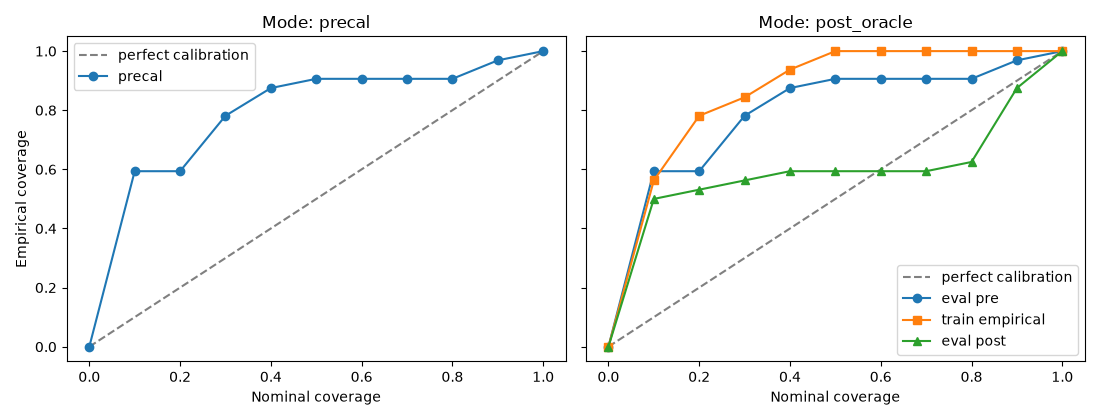
precal nominal coverages: [0.  0.1 0.2 0.3 0.4 0.5 0.6 0.7 0.8 0.9 1. ]
precal empirical coverages: [0.      0.59375 0.59375 0.78125 0.875   0.90625 0.90625 0.90625 0.90625
 0.96875 1.     ]
precal post block equals pre block: True
precal recalibrated nominal coverages: [0.  0.1 0.2 0.3 0.4 0.5 0.6 0.7 0.8 0.9 1. ]
Mode 2: post_oracle#
post_oracle means: fit a recalibration map on a matched train split and
evaluate it on a matched eval split. In the class API, this is the same
high-level method, but now with train_data, test_data, and fit=True.
post_oracle_calibrator = UncertaintyCalibrator(ue, me)
post_oracle_results = post_oracle_calibrator.calibrate(
    train_data=train_dataset,
    test_data=eval_dataset,
    fit=True,
)

print("post_oracle train empirical coverages:", post_oracle_results["train_empirical_coverages"])
print("post_oracle pre empirical coverages:", post_oracle_results["pre_calibration"]["empirical_coverages"])
print("post_oracle post empirical coverages:", post_oracle_results["post_calibration"]["empirical_coverages"])
print("post_oracle recalibrated nominal coverages:", post_oracle_results["post_calibration"]["recalibrated_nominal_coverages"])
post_oracle train empirical coverages: [0.      0.5625  0.78125 0.84375 0.9375  1.      1.      1.      1.
 1.      1.     ]
post_oracle pre empirical coverages: [0.      0.59375 0.59375 0.78125 0.875   0.90625 0.90625 0.90625 0.90625
 0.96875 1.     ]
post_oracle post empirical coverages: [0.      0.5     0.53125 0.5625  0.59375 0.59375 0.59375 0.59375 0.625
 0.875   1.     ]
post_oracle recalibrated nominal coverages: [0.         0.01777778 0.03555556 0.05333333 0.07111111 0.08888889
 0.11714286 0.16285714 0.23       0.36       1.        ]
The other workflow modes#
The remaining modes differ only in how the workflow constructs train_data
and test_data from aggregated datasets:
post_pooled: pooled train split across heads, matched eval condition;post_pooled_mismatch: pooled train split from mismatched condition;post_fixed: one reference train split, reused across many eval splits.
They still rely on the same high-level calibration logic demonstrated above.
Plot precal and post_oracle#
The first panel shows raw pre-calibration coverage. The second panel compares the matched post-calibration result against the raw eval curve and the training empirical curve used to fit the isotonic map.
fig, axes = plt.subplots(1, 2, figsize=(11, 4.2), sharey=True)

axes[0].plot([0, 1], [0, 1], "--", color="0.5", label="perfect calibration")
axes[0].plot(
    precal_results["pre_calibration"]["nominal_coverages"],
    precal_results["pre_calibration"]["empirical_coverages"],
    marker="o",
    label="precal",
)
axes[0].set(
    xlabel="Nominal coverage",
    ylabel="Empirical coverage",
    title="Mode: precal",
)
axes[0].legend(loc="best")

axes[1].plot([0, 1], [0, 1], "--", color="0.5", label="perfect calibration")
axes[1].plot(
    post_oracle_results["pre_calibration"]["nominal_coverages"],
    post_oracle_results["pre_calibration"]["empirical_coverages"],
    marker="o",
    label="eval pre",
)
axes[1].plot(
    post_oracle_results["pre_calibration"]["nominal_coverages"],
    post_oracle_results["train_empirical_coverages"],
    marker="s",
    label="train empirical",
)
axes[1].plot(
    post_oracle_results["post_calibration"]["nominal_coverages"],
    post_oracle_results["post_calibration"]["empirical_coverages"],
    marker="^",
    label="eval post",
)
axes[1].set(
    xlabel="Nominal coverage",
    title="Mode: post_oracle",
)
axes[1].legend(loc="best")

fig.tight_layout()
Inspect metric summaries#
UncertaintyCalibrator also returns the default calibration metrics from
MetricEvaluator for both the pre- and post-calibration curves.
print("precal metrics:", precal_results["pre_calibration"]["calibration_metrics"])
print("post_oracle pre metrics:", post_oracle_results["pre_calibration"]["calibration_metrics"])
print("post_oracle post metrics:", post_oracle_results["post_calibration"]["calibration_metrics"])
precal metrics: {'max_underconfidence_deviation': 0.0, 'max_overconfidence_deviation': 0.49375, 'mean_absolute_deviation': 0.26704545454545453, 'mean_signed_deviation': 0.26704545454545453}
post_oracle pre metrics: {'max_underconfidence_deviation': 0.0, 'max_overconfidence_deviation': 0.49375, 'mean_absolute_deviation': 0.26704545454545453, 'mean_signed_deviation': 0.26704545454545453}
post_oracle post metrics: {'max_underconfidence_deviation': 0.17500000000000004, 'max_overconfidence_deviation': 0.4, 'mean_absolute_deviation': 0.14488636363636367, 'mean_signed_deviation': 0.08806818181818178}
Summary#
UncertaintyCalibrator is the high-level API that realizes CaliBrain’s
calibration modes.
In this tutorial:
precalevaluated raw empirical coverage without fitting a map;post_oraclefitted isotonic recalibration on a matched train split and evaluated the recalibrated curve on a matched eval split;post_pooled,post_pooled_mismatch, andpost_fixedwere explained as workflow-level variations in how the train/eval splits are constructed.
Total running time of the script: (0 minutes 0.267 seconds)